🎧 Listen to this article
In short: An evening solitude practice transforms quiet hours into sacred space for self-discovery. Through intentional withdrawal from digital noise and social performance, you create conditions for genuine self-knowledge, inner silence, and the authentic presence that nourishes meaningful connection when you return to the world.
Since Ancient Contemplatives First Withdrew: The Forgotten Art of Evening Solitude
Since the desert fathers retreated at dusk and monastic communities observed the great silence after compline, evening has held particular power for inner work. The world naturally quiets. Defenses soften. The performed self that navigates daylight hours begins to dissolve.
In July 2026, this ancient rhythm collides with a culture that floods evening hours with streaming content, endless scrolling, and the peculiar loneliness of being constantly connected yet profoundly alone. You feel it: the exhaustion of visibility without intimacy, the hunger for something your packed calendar cannot name.
Evening solitude practice reclaims these hours not as empty time to fill but as fertile ground for the deep attention your soul requires. You are not withdrawing from life but preparing for truer participation in it.
The Architecture of Intentional Withdrawal: Creating Your Evening Container
Solitude requires architecture. Without deliberate boundaries, evening hours dissolve into passive consumption or the restless searching that masquerades as relaxation.
Your practice begins with temporal boundaries. Choose a specific threshold—perhaps 8 PM, perhaps earlier—when you ceremonially cross from the world of doing into the territory of being. This is not rigid discipline but loving structure, the way a potter’s hands shape the vessel that will hold water.
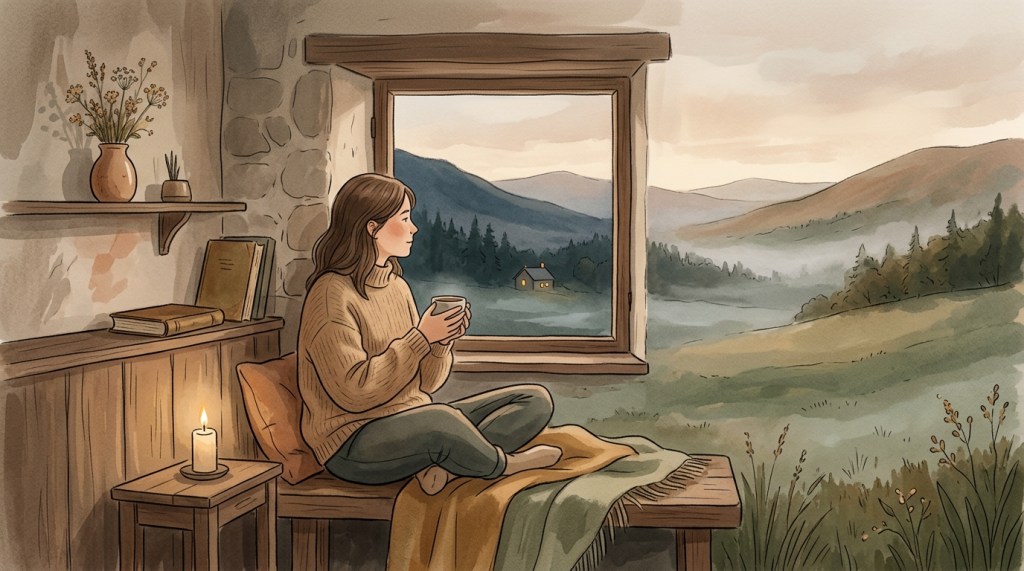
Create spatial markers that signal transition. A particular chair becomes your solitude seat. A lamp lit only for these hours. A blanket that wraps you in intention rather than distraction.
You are building a temple in time, a recurring sanctuary where your interior landscape can reveal itself without the constant interference of external demands and digital voices telling you who to be.
The Technology Boundary: Digital Sunset as Sacred Threshold
The most radical act of evening solitude in 2026 is turning off your devices before you feel ready. Not as punishment but as protection of the fragile space where your authentic voice can emerge.
Your phone holds a thousand voices louder than your own. Social media offers endless reflections of who you might become, drowning out knowledge of who you already are. The discipline is gentle but firm: these tools serve you during daylight hours, but evening belongs to deeper listening.
Place devices in another room. Create physical distance between your solitude practice and the magnetic pull of curated lives and artificial urgency. The first nights feel uncomfortable, even frightening. This discomfort is information—revealing how thoroughly you have outsourced the capacity to be alone with yourself.
The Companionship of Silence: What Emerges When Noise Recedes
True silence is not absence but presence. When evening solitude becomes practice rather than accident, you discover that silence has texture, depth, layers of meaning your hurried days never permit you to notice.
You hear the actual sounds your environment makes—the hum of refrigerator, the settling of walls, wind moving through spaces you had forgotten to notice. You become aware of your breath, your heartbeat, the subtle currents of sensation moving through your body.
Beneath these physical sounds lies something more profound: the voice of your own thinking unmediated by performance or reaction. Thoughts arise not as responses to external stimuli but as genuine movements of your interior life. You begin to distinguish between the anxious mental chatter that fills empty space and the quieter, wiser voice that speaks only when given room.
The Pillar of Inner Silence: Cultivating the Ground of Self-Knowledge
Inner silence is not the absence of thought but the presence of spaciousness around thought. In evening solitude practice, you are not trying to empty your mind—you are learning to witness your mind without being entirely consumed by it.
Begin simply. Sit in your designated space and notice what arises. Worries about tomorrow. Replays of today’s conversations. Plans, fears, fantasies, judgments. Your work is not to suppress these but to observe them with the same gentle curiosity you might bring to watching birds at a feeder.
You discover that you are not identical to your thoughts. There is a you who thinks and a you who notices the thinking. This distinction, practiced consistently over weeks and months, creates the inner silence from which genuine self-knowledge emerges.
In July 2026, this capacity feels countercultural and essential. The world wants your reaction, your opinion, your immediate response. Evening solitude practice teaches you to pause, to allow the reactive mind to settle, to access the deeper wisdom that speaks in slower rhythms.
Witnessing Without Judgment: The Practice of Loving Observation
Your harshest critic often arrives during solitude. The voice that catalogs failures, rehearses shame, compares your interior reality to others’ curated exteriors. Evening practice teaches you to notice this voice without granting it authority.
When self-judgment arises, you practice a different response: acknowledgment without identification. « There is the critical voice, » you observe, not « I am worthless. » This subtle shift changes everything. You are the vast sky, not the passing weather.
Over time, this witnessing becomes almost tender. You begin to recognize the wounded child behind harsh self-talk, the frightened part that believes perfectionism offers safety. Your evening solitude becomes a space where these parts of you can be seen without being shamed—the first step toward integration and genuine self-compassion.
The Pillar of Self-Knowledge: Meeting Yourself as Unfamiliar Territory
Self-knowledge is not narcissism. It is the difficult, humble work of becoming acquainted with your actual patterns, values, longings, and limitations rather than the idealized or condemned versions your ego prefers.
Evening solitude creates conditions for this acquaintance. Without the distraction of external validation or the performance of social identity, you encounter yourself more nakedly. You notice what genuinely brings you alive versus what you do from obligation or fear. You discover desires you have been too busy or too defended to acknowledge.
This is uncomfortable work. You will meet parts of yourself that disappoint you, contradictions you cannot easily resolve, longings that seem impractical or foolish. The practice asks you to meet these discoveries without rushing to fix or explain them—simply to know them as true.
The Inquiry Practice: Questions That Open Interior Doors
Evening solitude deepens when paired with gentle inquiry. Not aggressive interrogation but curious questioning that invites your interior world to reveal itself.
Keep a dedicated journal for these hours. Write slowly, by hand if possible, letting the physical act of forming letters create rhythm for emergence. Ask questions like: What brought me alive today? What depleted me? What am I avoiding knowing? What do I long for that I have not spoken aloud?
Do not force answers. Sometimes the questions themselves are the practice, creating space for insights that arrive days later in unexpected moments. You are cultivating relationship with your own depths, and like any meaningful relationship, this requires patience, consistency, and the willingness to be surprised.
The Pillar of Authentic Presence: How Solitude Nourishes Connection
The paradox of evening solitude practice is that withdrawal from constant connection actually enhances your capacity for authentic relationship. When you know yourself more intimately, you can meet others from ground rather than hunger, from presence rather than performance.
You discover that much of what you called connection was actually mutual distraction—scrolling together, filling silence with words, performing versions of yourself that require exhausting maintenance. True presence requires the inner stability that only solitude cultivates.
In July 2026, as you establish this practice, notice how it changes your daylight interactions. You listen more deeply because you are not constantly planning your response. You tolerate authentic disagreement because your sense of self no longer depends on others’ approval. You choose connection consciously rather than seeking it compulsively.
The Return: Bringing Solitude Wisdom into Relational Life
Evening solitude is not an end in itself but preparation for more authentic participation in the world. What you discover in silence becomes resource for showing up more truthfully in relationship.
You learn to recognize when you are operating from performance versus presence. You develop the capacity to say « I need to think about that » rather than responding reactively. You discover which relationships actually nourish you and which deplete you through inauthenticity or constant accommodation.
This is not selfishness but stewardship of the particular gifts and limitations that make you who you are. You cannot offer genuine love from an empty or unknown self. Evening solitude fills the wells from which authentic connection flows.
Creating Sacred Routine: Practices That Anchor Evening Hours
Establish simple, repeatable practices that signal to your body and psyche that you are crossing into solitude space. Light the same candle each evening. Brew tea with deliberate attention. Wrap yourself in the same blanket, sit in the same chair, create sensory continuity that your nervous system learns to recognize as safe.
You might read poetry slowly, letting each line settle before moving to the next. You might practice gentle movement—yoga, stretching, walking slowly through your space. You might simply sit and breathe, counting breaths or following sensation, anchoring awareness in body rather than mental narrative.
The specific practice matters less than consistency and intention. You are training yourself to value this time, to protect it from the thousand small urgencies that will try to colonize these hours if you allow them.
The Long Transformation: What Months of Practice Reveal
Evening solitude practice does not offer instant results or dramatic breakthroughs. Its gifts accumulate slowly, like sediment building into bedrock over seasons and years.
After weeks, you notice subtle shifts. You sleep more deeply. Your reactivity softens. You recover more quickly from emotional disruption because you have developed capacity to witness your interior weather without being entirely at its mercy.
After months, the changes run deeper. You know yourself well enough to make choices aligned with actual values rather than inherited scripts or fear-based impulses. You tolerate being disliked because your sense of worth no longer depends entirely on external validation. You choose solitude sometimes even when connection is available, recognizing it as nourishment rather than punishment.
This is the quiet revolution that evening practice offers: not dramatic transformation but gradual alignment with who you actually are beneath the performed selves that navigate daylight demands.
Key takeaways
- Evening solitude practice transforms quiet hours into intentional space for self-discovery by establishing boundaries around time, space, and technology that protect inner attention from constant external demands.
- Inner silence emerges not from suppressing thoughts but from witnessing them with gentle curiosity, creating spaciousness that allows your deeper wisdom to become audible beneath reactive mental chatter.
- Self-knowledge develops through consistent inquiry and observation practiced without judgment, revealing your authentic patterns, values, and longings beneath idealized or condemned self-images.
- Authentic presence in relationships depends on the inner stability cultivated through solitude—knowing yourself deeply enough to meet others from groundedness rather than performance or hunger for validation.
- Sustainable practice requires simple, repeatable rituals that signal transition into solitude space and accumulates benefits slowly over months rather than offering instant transformation.
- The paradox of withdrawal is that intentional solitude actually enhances capacity for genuine connection by developing the self-knowledge and presence that meaningful relationships require.
FAQ
How long should an evening solitude practice last to be effective?
An effective evening solitude practice typically lasts 30 to 90 minutes, though even 15 minutes practiced consistently offers more benefit than occasional longer sessions. The key is regularity rather than duration—your nervous system learns to settle more quickly when practice occurs at the same time each evening. Begin with whatever duration feels sustainable, gradually extending as the practice becomes anchored in your routine.
What if I feel anxious or uncomfortable during evening solitude rather than peaceful?
Discomfort during initial solitude practice is normal and actually informative, revealing how thoroughly you have learned to avoid being alone with yourself. Anxiety often intensifies temporarily when you remove habitual distractions that have been masking it. Stay with the discomfort gently, treating it as a visitor rather than an emergency. Over weeks, your nervous system learns that solitude is safe, and the anxiety typically softens as you develop capacity to witness it without being consumed.
Can evening solitude practice work for people living with others or in small spaces?
Evening solitude absolutely works in shared living situations through clear communication and creative boundary-setting. Communicate your practice to housemates or family, establishing that certain hours are your protected time. Even in small spaces, you can create solitude through headphones playing gentle sounds, a privacy screen, or simply a designated chair that others understand as your practice space. Temporal boundaries often matter more than physical ones—the commitment to turn inward matters more than having a separate room.
Is evening solitude practice the same as meditation?
Evening solitude practice is broader than formal meditation, though it may include meditation as one element. Meditation typically involves specific techniques like breath focus or body scanning, while solitude practice encompasses the entire architecture of intentional withdrawal—turning off devices, creating sacred space, journaling, reading contemplatively, or simply sitting in receptive awareness. Think of meditation as one practice within the larger container of solitude, which holds space for various forms of deep attention and self-encounter.
How do I maintain evening solitude practice when my schedule is unpredictable?
Maintain practice during unpredictable schedules by focusing on the quality of withdrawal rather than rigid timing, and by abbreviating rather than abandoning the practice when time is limited. Even 10 minutes of intentional solitude—phone off, sitting quietly—preserves the thread of practice when full sessions are impossible. Consider the essence of your practice (inner silence, self-knowledge, presence) and find the smallest sustainable version that honors those intentions. Consistency of intention matters more than consistency of duration.
What is the relationship between evening solitude and loneliness?
Evening solitude and loneliness are fundamentally different experiences, though they can feel similar initially. Loneliness is the painful sense of unwanted isolation and disconnection from others, while solitude is chosen withdrawal that actually deepens your capacity for authentic connection. In practice, regular solitude often reduces chronic loneliness by developing the self-knowledge and inner stability that allow you to show up more genuinely in relationships. When you know and accept yourself through solitude, you seek connection from fullness rather than desperate hunger, which paradoxically makes meaningful connection more available.
Read also
- When Love Arrives Slowly: Recognition, Patience, and the Beauty of Being Truly Seen
- Full Moon Ritual: Release, Gratitude, and Lunar Energy Alignment (July 2026)
- Full Moon Ritual: Release Tension, Embrace Gratitude, and Align with Lunar Energy in July 2026
 Synchronicity