🎧 Listen to this article
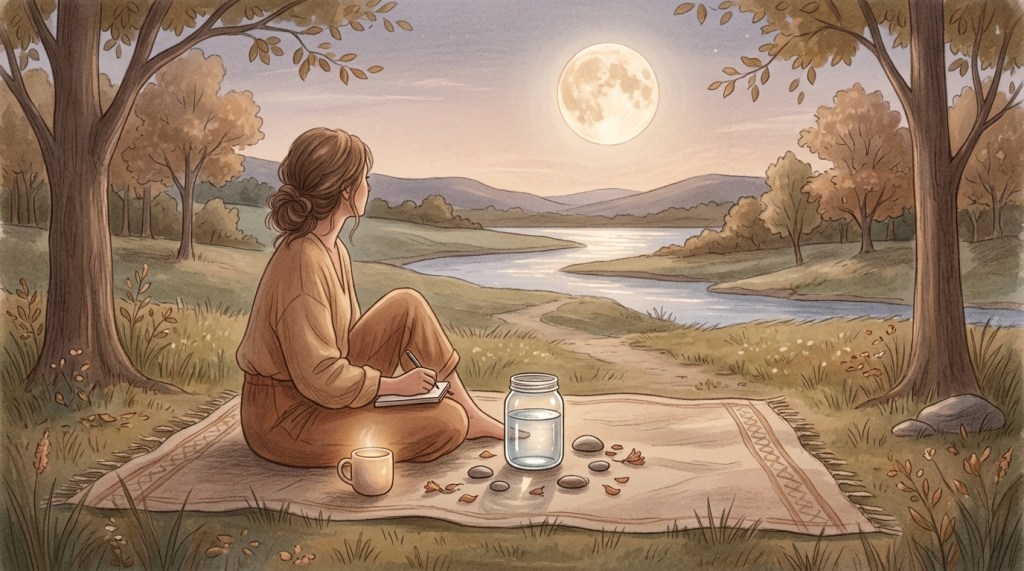
In short: A full moon ritual is a deliberate pause — typically involving written release, named gratitudes, and a stated intention — that uses the visibility of the full moon as a calendar anchor for personal reflection. In September 2026, this practice falls on the 26th at 16:49 UTC, four days after the autumn equinox, making it a naturally resonant moment for honest relational inventory.
—
Why September 2026 Feels Like the Right Moment to Stop and Look
You know that particular tiredness — not the kind that sleep fixes. It is the fatigue of going through the motions: conversations that skim the surface, connections that promise depth and deliver distraction, a quiet suspicion that something genuine keeps slipping just out of reach.
What you feel is not weakness. It is the honest signal of someone who has refused to settle and is now paying attention to the cost of that refusal.
The full moon on September 26, 2026 — reaching its peak at 16:49 UTC, according to astronomical data from Space.com and TimeandDate.com — arrives just four days after the autumn equinox of September 22nd. Astronomers call this the Harvest Moon: the full moon closest to the equinox, historically significant because its light extends the evening hours during the gathering season. That seasonal timing is not mystical. It is simply well-placed: autumn already invites inventory, and this particular evening offers a clear sky and a concrete date to use as a hinge.
A full moon ritual, understood soberly, is nothing more and nothing less than a structured pause. It is a way of using an astronomical event as a legitimate prompt to ask honest questions about your interior life and your relational world.
—
What Does a Full Moon Ritual Actually Involve?
A full moon ritual is a personal reflective practice — usually written, quiet, and brief — organized around three movements: naming what you want to release, expressing genuine gratitude, and stating a forward-facing intention. It requires no special equipment, no particular belief system, and no performance.
The value is not in the moon itself. The moon provides the date, the visibility, and the metaphor. The work is entirely yours.
The Three Movements in Practice
Release. Sit with a blank page and write, without editing, what you are carrying that no longer serves your growth. This might be a pattern of chasing unavailability. It might be a habit of explaining yourself before you are even asked. It might be the story you tell about why connection keeps failing. Writing it down — physically, with a pen — is not ceremonial theater. It is a cognitive act: externalizing a thought loosens its grip.
Gratitude. Name three things, specifically, that have genuinely nourished you in your relational life this season. Not abstract blessings. Concrete moments: a conversation where someone stayed present, a boundary you held without apology, a morning where you felt at ease in your own company. A growing body of reflective practice research suggests that specificity in gratitude — naming the exact moment rather than the general feeling — anchors the recognition more durably in your sense of self.
Intention. Write one sentence describing the quality of connection you are moving toward. Not a person. Not an outcome. A quality: presence, reciprocity, ease, honesty. This distinction matters enormously. An intention aimed at a person is a wish. An intention aimed at a quality is a compass.
—
Is There Any Real Effect of the Full Moon on Human Emotions?
The honest answer is: no robust scientific evidence supports the idea that the full moon directly influences human emotional states or relational behavior. The astronomical event is real and precisely dated. The effects attributed to it — heightened sensitivity, increased openness, energetic shifts — are not empirically established.
Presenting lunar energy as a metaphor, however, is both intellectually honest and practically useful. A metaphor does not need to be literally true to be functionally effective. When you say « I am using this full moon as a marker to reflect, » you are doing something entirely legitimate: you are borrowing the rhythm of the natural world to structure an interior practice. The moon becomes a reliable external cue, the way a Sunday evening or a birthday can prompt reflection that a random Tuesday rarely does.
This distinction — between metaphor and mechanism — is worth anchoring clearly. It protects you from the disillusionment that follows magical thinking, and it preserves the genuine value of the practice itself.
—
How to Prepare the Conditions for Genuine Reflection
The quality of a reflective ritual depends almost entirely on the conditions you create around it, not on the ritual itself.
Creating a Container for Honesty
Choose a time when you will not be interrupted — ideally after dark on September 26th or the evening adjacent to it, since the moon will be fully visible on neighboring nights as well. Dim the artificial light. Put your phone in another room, not on silent — in another room. The habit of ambient distraction is precisely what this practice is designed to interrupt.
Bring something to write with and something to write on. The analog quality of pen and paper is not nostalgia; it is neuroscience. Handwriting activates encoding processes that typing does not replicate at the same depth.
The Duration Question
Twenty to thirty minutes is sufficient. Longer is not better. The goal is focused honesty, not extended performance. If you find yourself filling pages, you may be processing productively — or you may be avoiding the one sentence that actually matters. Notice the difference.
—
What This Practice Reveals About Your Relational Patterns
The September 2026 full moon ritual, understood as a reflective anchor rather than a spiritual event, tends to surface one of three recognitions:
You have been giving more than you have been receiving. The gratitude exercise, when done honestly, often reveals a lopsided ledger. If your three concrete moments of relational nourishment are all things you provided for others, that asymmetry is worth naming directly.
You are holding onto something past its useful life. The release exercise frequently uncovers attachments that intellectual awareness alone had not dislodged — a hope kept alive through careful vagueness, a resentment maintained as protection.
Your stated intention and your actual behavior are not aligned. Writing the intention you want to move toward can illuminate, uncomfortably, the gap between what you say you want and how you have been living. This discomfort is not failure. It is the beginning of useful change.
—
Closing the Ritual with Integrity
End the practice with a deliberate closing gesture — not because ceremony is required, but because the mind benefits from clear transitions. This might be as simple as reading aloud the intention you wrote, folding the release page and setting it aside, or stepping outside briefly to observe the night sky.
What you do afterward matters more than the ritual itself. The intention you wrote is only meaningful if it informs a choice within the next forty-eight hours — however small. Send the message you have been postponing. Decline the invitation that drains you. Ask the question you have been careful to avoid.
The full moon on September 26, 2026 is a date. What you make of it is entirely yours.
—
Key Takeaways
- The September 2026 full moon peaks on September 26th at 16:49 UTC, four days after the autumn equinox, making it a naturally anchored moment for personal and relational reflection.
- A full moon ritual is a structured reflective practice built on three movements — release, gratitude, and intention — that does not require any specific belief system to be effective.
- No scientific evidence supports a direct emotional effect of the full moon; its value as a ritual anchor is metaphorical and practical, not mechanical.
- Specificity is the key variable in both the gratitude and release exercises: vague reflection produces vague results, while named concrete moments produce durable self-knowledge.
- An intention aimed at a relational quality — presence, reciprocity, honesty — functions as a compass, while an intention aimed at a specific person or outcome functions only as a wish.
- The ritual’s real value lies in what it reveals about existing patterns and what single concrete action it motivates within forty-eight hours of the practice.
FAQ
What is a full moon ritual and how does it work?
A full moon ritual is a structured reflective practice — typically written — organized around three movements: naming what you want to release, expressing specific gratitudes, and stating a forward-facing intention. It uses the full moon as a calendar anchor and a contemplative metaphor, not as a mechanism with demonstrated emotional effects. The practice works by creating a deliberate pause that interrupts habitual distraction and invites honest self-inventory.
When exactly is the full moon in September 2026?
The September 2026 full moon reaches its peak on September 26th at 16:49 UTC, according to astronomical data from Space.com and TimeandDate.com. Because it falls just four days after the autumn equinox of September 22nd, it carries the astronomical designation of Harvest Moon. The moon is fully visible on the evenings surrounding that date, so the ritual can be performed the night of the 26th or the adjacent evenings.
Does the full moon actually affect emotions or relationships?
No robust scientific evidence establishes a direct effect of the full moon on human emotions or relational behavior. The value of framing a reflective practice around the full moon is metaphorical: the moon provides a reliable, recurring external cue that prompts structured reflection in the way a birthday or a seasonal shift might. Presenting lunar influence as metaphor rather than mechanism is both intellectually honest and practically effective.
How long should a full moon ritual last?
Twenty to thirty minutes is sufficient for a meaningful full moon ritual. Longer duration does not produce proportionally deeper reflection; focused honesty within a contained time frame tends to yield more usable insights than extended journaling without clear structure. The three-part framework — release, gratitude, intention — can be completed within that window when approached with genuine attention.
What should I write during a full moon ritual for emotional release?
Write, without editing, what you are carrying that no longer serves your growth — a relational pattern, a narrative about yourself, a hope you are maintaining through deliberate vagueness. Specificity matters: name the pattern concretely rather than describing it in general terms. Writing by hand rather than typing deepens the encoding process and helps externalize the thought, which loosens its hold on your day-to-day emotional responses.
How is a full moon ritual different from other reflective practices?
A full moon ritual differs from general journaling primarily in its external anchor and its three-part structure. The astronomical event provides a fixed, recurring date that removes the decision fatigue of choosing when to reflect, and the sequential structure — release, then gratitude, then intention — creates a directional arc that moves from the past toward the future within a single sitting. This makes it more actionable than open-ended journaling and more grounded than purely aspirational visioning practices.
Read also
- Autumn Equinox Ritual in 2026: Gratitude, Harvest, and Inner Balance on September 23rd—Three Grounded Practices That Align Your Emotional Rhythms, Honor Natural Cycles Without Spiritual Bypassing, and Reclaim 64% More Clarity for Your Next Relational Chapter
- Slow Dating and Patience in 2026: How to Slow Your Pace Without Becoming Passive, Three Early-Exchange Criteria That Guard Your Clarity, and Why 78% Who Reclaim Deliberate Rhythm Report Deeper Connection Instead of Burnout
- Chosen Solitude vs Imposed Isolation in 2026: Three Behavioral Markers That Reveal Whether Your Alone Time Is Restorative Protection or Masked Loneliness, Plus a Four-Question Discernment Framework That Prevents Self-Deception
 Synchronicity