🎧 Listen to this article
In short: Rediscovering the desire to date again without forcing yourself means learning to recognize a quiet internal shift — a returning curiosity about connection — without immediately translating it into action. It involves distinguishing genuine readiness from social pressure, and allowing that desire to unfold at its own pace before committing to any dating context.
—
> In brief > – Notice the returning pull toward connection before deciding what to do with it. > – Distinguish between genuine desire and the pressure to « get back out there. » > – Let curiosity lead, without converting it immediately into dates or apps.
—
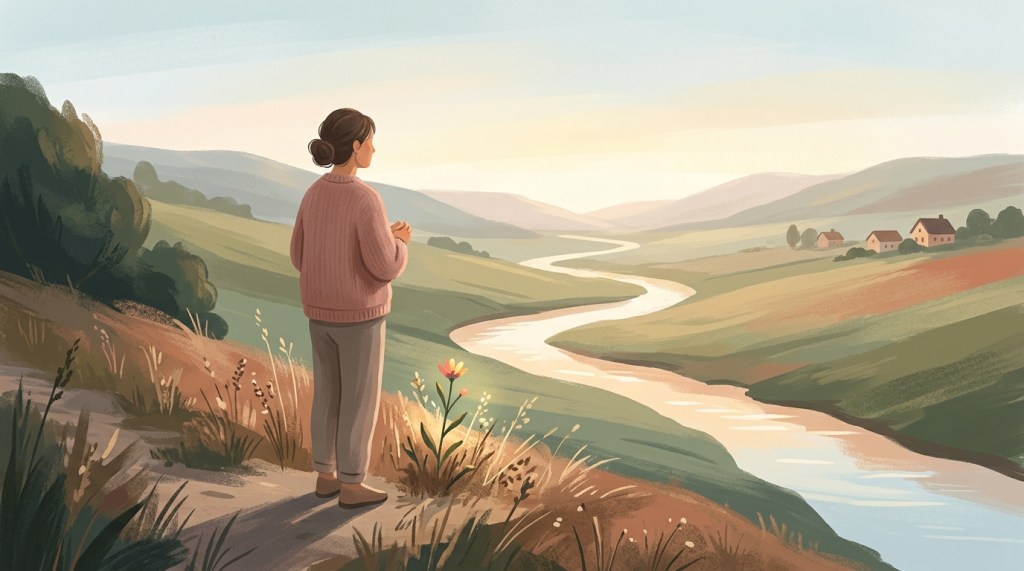
Thursday evening, 9:40 p.m. You’re sitting with a book you haven’t been able to focus on for twenty minutes. A friend texted a photo from dinner — her partner refilling her glass without being asked, both of them laughing at something just out of frame. You set the phone down. Something stirs. Not longing exactly, not sadness. Something quieter.
What you’re feeling isn’t a signal that you’ve failed to move on — it’s the first faint note of desire returning on its own terms.
—
A soft return is not the same as being ready to rush back in
There is a particular confusion that arrives when desire begins to resurface after a period of withdrawal. Society tends to interpret any flicker of romantic interest as a green light for immediate action: update your profile, say yes to the setup, download the app. The logic is that desire must be harnessed before it fades.
But desire that returns gently rarely asks to be harnessed. It asks to be noticed.
This distinction matters because rushing the return — especially toward platforms that reward volume and speed — often extinguishes the very feeling you were hoping to honour. The desire contracts back into silence, and you’re left wondering whether you were ever truly ready.
What does it actually feel like when the desire to connect comes back?
It comes back in small, almost incidental moments: a conversation with a stranger that you wish had lasted longer, a film that moves you without making you sad, a Sunday morning when being alone feels like a choice rather than a sentence. The feeling is not yet romantic in a targeted sense. It is more like a gentle reopening of attention toward other people.
This quality — diffuse, ambient, unhurried — is its most important characteristic. It tells you that the desire is real rather than reactive.
—
The difference between wanting connection and feeling obligated to date
In Canada, more than a third of adults reported feeling lonely at least sometimes in recent years. In France, among adults in their thirties, the figure climbs closer to one in three experiencing frequent loneliness. These numbers describe something real: the weight of living without enough close contact.
But they also reveal a trap. When loneliness becomes visible and widely acknowledged, it can quietly transform into pressure — the idea that if you feel alone, you should be actively dating. That the solution to one is always the other.
Wanting presence, conversation, warmth, or tenderness is not the same as being ready for a relationship structure. Confusing the two leads to dates taken for the wrong reasons, interactions that feel hollow, and a reinforced sense that « it just doesn’t work for me. »
The more honest question is not should I start dating again? but what kind of connection am I actually hungry for right now?
—
How do you know whether your desire to date again is genuine?
Genuine desire to date again tends to be accompanied by curiosity rather than anxiety. You find yourself wondering who someone is rather than worrying about whether they’ll like you. You feel drawn toward discovery rather than toward the relief of not being alone anymore.
Anxiety-driven re-entry looks different. It pushes you toward volume — more profiles, more conversations, more second dates — in hopes that the sheer number of attempts will eventually produce a result. It treats connection as a problem to be solved rather than an experience to be had.
If you sit quietly and ask yourself do I actually want to meet someone, or do I want to stop feeling like I should want to? the answer that surfaces is usually trustworthy.
Is it normal to want connection without wanting to use dating apps right now?
Yes — and more people than you might expect find themselves in exactly this position. Apps are one context for meeting people, not the only one, and not always the right one at a particular moment. Wanting connection while feeling reluctant to return to swiping is not contradictory. It may simply mean that you are ready for a different kind of environment: slower, more intentional, less dependent on immediate judgment.
Some people find that what they want is not necessarily a formal date but a conversation that has a chance of becoming something. That distinction is worth keeping.
—
Letting the desire breathe before you act on it
There is a practice that sounds simple and proves surprisingly difficult: noticing the desire without immediately converting it into a decision. When the pull toward connection surfaces on a quiet evening, you do not have to open an app, text someone you haven’t thought of in months, or begin planning how you’ll re-enter the dating world. You can simply register that the feeling is there.
This matters because desire that is acknowledged without being immediately instrumentalized tends to grow more specific over time. What begins as a vague pull toward warmth clarifies into a sense of what kind of person you’d like to spend time with, what kind of conversation you miss, what you’re no longer willing to settle for.
That specificity is useful. It will serve you better when you do decide to move forward than any amount of activity undertaken before you were actually ready.
—
Moving at a pace that belongs to you
When the moment arrives that the desire feels clear enough to act on, the question becomes how — not how fast. Slow dating, in its most essential form, is not a trend or a technique. It is simply the choice to let interest develop before committing to escalation. To have a second conversation before planning a first date. To let curiosity accumulate before investing in outcome.
This approach asks something of you: the willingness to stay with uncertainty a little longer than is comfortable. But it also protects something: the quality of what unfolds, and the sense that you arrived at it freely.
Synchronicity was built around exactly this kind of pace. If you feel drawn toward connection but not toward volume or speed, you might find it worth exploring — Discover Synchronicity encounters.
—
Key takeaways
- Rediscovering the desire to date again often begins as a diffuse, ambient feeling — a returning curiosity about others — rather than a clear decision.
- Distinguishing genuine desire from social pressure is the most important first step; genuine desire tends to be accompanied by curiosity rather than anxiety.
- Loneliness statistics from Canada and France reflect a real human need for connection, but they do not mean that dating apps are the only or most appropriate response for everyone.
- Wanting connection without wanting to return to high-volume dating contexts is a coherent position, not a contradiction.
- Allowing desire to clarify before acting on it produces better outcomes than rushing toward activity before readiness is real.
- Slow, intentional dating environments — where pace is chosen and curiosity is valued over volume — tend to align better with this kind of returning desire.
FAQ
How do I know if I genuinely want to start dating again or if I’m just reacting to loneliness?
Genuine desire to date again tends to feel curious and open, while loneliness-driven urgency tends to feel anxious and focused on escape. Ask yourself whether you want to discover someone or whether you want to stop feeling alone — the answer is usually honest. If the pull is toward connection for its own sake, that is a reliable signal.
Is it okay to want connection without going back to dating apps?
Yes — feeling drawn toward connection while being reluctant to return to apps is a coherent and common experience. Apps are one context among several for meeting people, and not always the right fit at a particular moment. Slower, more intentional environments often serve people who are returning to dating after a period of withdrawal more effectively.
What does it mean to let desire return at its own pace?
It means noticing the pull toward connection without immediately converting it into action: no profiles, no plans, no decisions. When desire is acknowledged without being rushed into outcomes, it tends to clarify over time — becoming more specific about what you actually want, which makes any future steps more grounded.
How long should I wait before dating again after a period of withdrawal?
There is no fixed timeline for knowing when you’re ready to date again after stepping back. The more useful signal is qualitative: when curiosity about others feels natural rather than forced, and when the thought of meeting someone generates more interest than dread. Readiness is a feeling, not a date on the calendar.
Can slow dating actually help when you’re rediscovering the desire to meet someone?
Slow dating — where pace is chosen and curiosity is valued over volume — tends to align well with a returning desire that is still fragile or undefined. It reduces the pressure to perform readiness before you feel it, and allows a connection to develop from genuine interest rather than from the anxiety of keeping up with a fast-moving format.

